

Utah's Whole House Water Filtration Checklist

simplify

Congratulations on choosing to buy a Kinetico home water filtration system for your home! Purchasing a home filtration system is one of the best choices you make when it comes to taking care of your family and home. You and your loved ones deserve to have safe and clean water without having to invest in products that require you to continually invest more money or more of your precious time, time that you can’t get back.

Below is a simple checklist along with related links to help you understand the undisputed value of a Kinetico Quality Water Filtration System.

  • Warranty –Kinetico is known to have the best warranty in the industry. Don’t let anyone fool you. Make sure you understand that a lifetime warranty doesn’t mean “your lifetime”. If you sell your home and the Kinetico Home Water Filtration System is kept at the original installation sight, it will still be under warranty. If you move and want to take your home filtration system with you, you will still be covered under warranty. Learn more at about the water filtration warranty.
  • Water Test –We take a water sample to determine the best sized water filtration system for your home.  Click here for more information about a free water test.
  • Non-electric- Kinetico is a Non-electric patented home water filtration system that uses natural engineering without taking a toll on the environment. Learn more about the benefits of home filtration today.
  • Dual Tanks- The Kinetico Dual tank water filtration system allows an uninterrupted supply of soft water enabling consistent regeneration of soft water protecting the water filtration system, requiring less salt and the reason why a Kinetico Home Filtration System lasts much longer than any other system on the market!
  • Customization- We offer several different water filtration systems to address a variety of water problems. Some of the less desirable contaminants include: Chlorine, Iron, Calcium, Magnesium, Hydrogen Sulfide (rotten egg smell) Learn more about a variety of water problems and contaminants here.
  • Certifications- A Kinetico Home Filtration System is certified through the Water Quality Association and also by NSF International. Learn more about the NSF mark and Kinetico certifications.
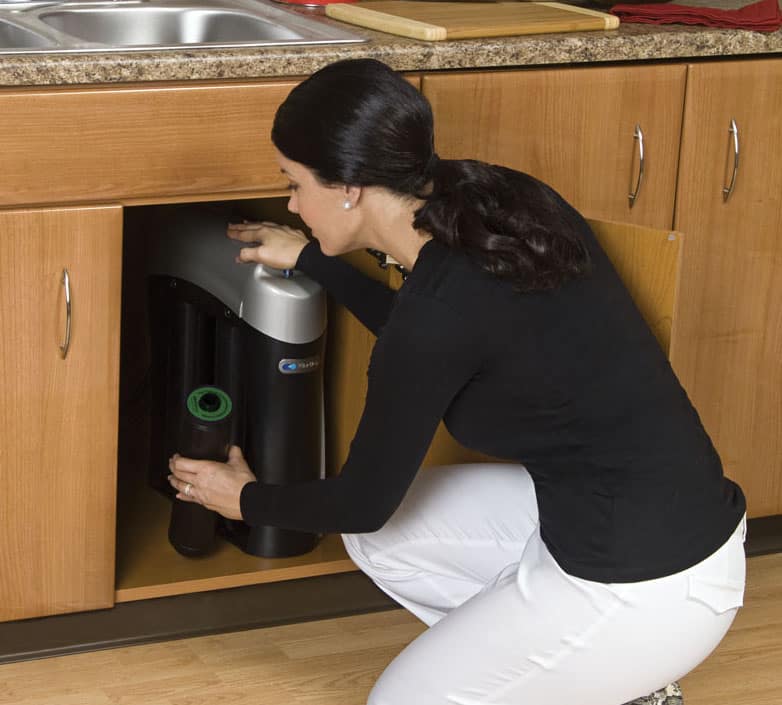
Which Water Filter is Best for Me?

under sink

There are many different types of water filters and it’s easy to become confused about what type of water filtration is best going to solve your specific water problem. Water filters can be placed into four different categories, sediment, carbon, reverse osmosis (RO) and distillation.

Sediment: This type of water filter is used to remove particulates from the water like dirt, oxidized iron, and other particles that are suspended in the water. A sediment filter acts like a very small screen that filters out the sediments in the water. Sediment filters are sized by the size of particle they remove and can be very small to take out very fine materials like silica or much larger for removing sand from the water.

Carbon: Carbon filters are the most common type of water filter and are a key component of virtually every home water purification system. Carbon is very effective at removing dirt and sediments from water, chlorine, and many other chemicals. Carbon filters have very fine pores that are able to trap the particulates. In addition, the carbon acts like a sponge and is able to absorb the chlorine and other chemicals. It is very important to change the filter as the manufacture recommends ensuring the effectiveness of the filter. This type of filtration is used primarily to improve the taste of water and in removing the objectionable odors, like chlorine.

Reverse Osmosis: This is the most common way to purify water for drinking and cooking. A reverse osmosis system incorporates carbon filtration and a semi permeable membrane. The membrane is used to remove Total Dissolved Solids (TDS) which are minerals, salts, heavy metals, etc. that have dissolved into the water. This provides excellent tasting water that has as much as 99% of most of the impurities that can be in the water removed.

Distillation: A Distiller boils the water and the condensation is collected leaving the total dissolved solids behind, very similar to boiling water in a tea pot and the scale residue collects on the bottle of the kettle. This is an effective way to produce purified water, although, many object to the flat taste the water has.

Comments are closed.